Solidity•Smart contracts•DeFi•Ethereum & Aleo
Solidity & Smart Contract Development for DeFi Teams
From protocol design to production-deployed contracts.
And everything around them: indexers, APIs, keepers, bots and the dashboards your users actually touch. On-chain logic is only half the system.
- Smart contracts & protocol design
- DeFi: AMMs, vaults, staking
- Trading & liquidity automation
- Zero-knowledge (Aleo · Leo)
Protocols I have built
ZKPerp
TestnetA privacy-preserving perpetual futures DEX on Aleo: up to 20× leverage while position size, entry price and PnL stay encrypted. Winner at the Aleo Buildathon.
TrustLayer-AMM
TestnetA credit-tier AMM combining Aleo privacy with Uniswap V4 hooks. Traders prove their tier without revealing their score, and get better fees for it.
HumanityLink
PilotPrivate stablecoin payments for humanitarian aid: spendable from a QR code, auditable in aggregate, live in pilots with two NGOs.
Four areas, one stack
Most engagements land in one of these — and usually spill into the next one, because a contract without an indexer, a keeper and a dashboard is not a product yet.
Smart contracts
Contracts designed for audit from day one: clear roles, explicit storage layout, proven libraries, full test coverage.
DeFi protocols
Pool math, fee accounting and incentive design — the parts where an off-by-one costs real money.
Backend & infra
Event indexing, APIs and workers that keep running when an RPC node goes down or a chain reorgs.
Trading systems
Bots that manage positions and liquidity on-chain, with the analytics to see whether they are actually making money.
ZKPerp
Private perpetual futures DEX on Aleo
On every other perpetuals venue your position size, entry price, leverage and PnL are permanently public — so bots front-run your orders and other traders hunt your liquidation level. ZKPerp keeps all of it encrypted. You can go long or short on BTC, ETH and SOL with up to 20× leverage, set limits, take-profits and stop-losses, or provide liquidity to the pool. Large orders route through a built-in dark pool that matches in sealed batch auctions, so size can be filled without moving the market. Live on Aleo testnet; winner at the Aleo Buildathon.
- Private positions
- Encrypted PnL
- Liquidation engine
- Dark pool batch auctions
- Up to 20× leverage
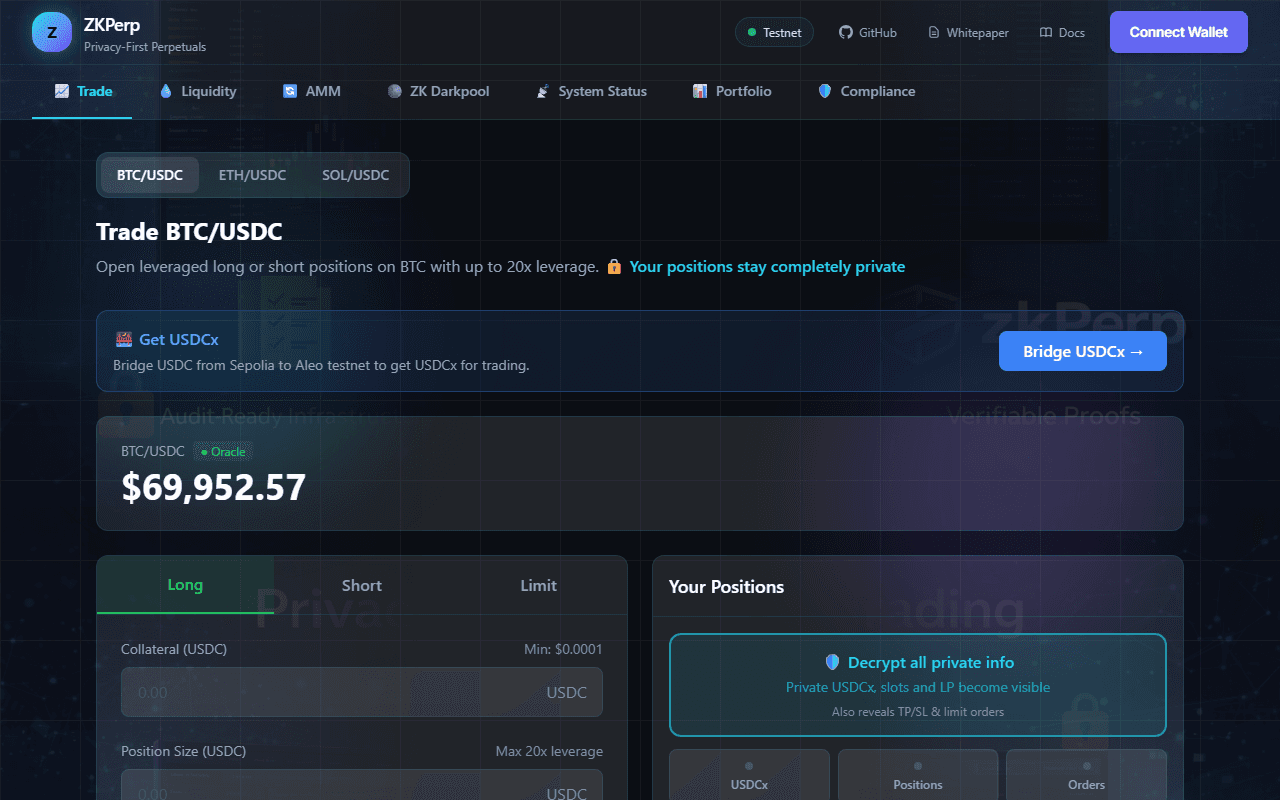
What happens when a trade is placed
The network verifies that a trade is valid — real collateral, correct price, honest payout — without ever seeing the numbers behind it. The position record stays encrypted to the trader; only the aggregate state the protocol needs to function is public. That split between what is proven and what is revealed is the whole design problem, and it is the kind of decision I get paid to make.
From spec to mainnet in four steps
- 1
Spec & scope
We turn the idea into concrete requirements, edge cases and constraints — including the failure modes nobody likes writing down.
- 2
Contract architecture
Roles, storage layout, upgradeability, interaction patterns and where value can get stuck. Decided before a line is written.
- 3
Implementation & tests
Clean Solidity or Leo on proven libraries, with unit, integration and fork tests in Foundry or Hardhat, plus simulations where it helps.
- 4
Audit prep & deploy
Documentation, deployment scripts, monitoring and support through the audit and the launch itself.
A good fit when
- You have a protocol idea but no spec yet.
- You need someone who understands the on-chain logic and the backend around it.
- You want to move fast, but with audits and production in mind from day one.
- You have contracts already and want them extended, refactored or documented properly.
Tools that survive an audit
Proven libraries over clever code. Everything is tested, scripted and documented, so the handover is a repository rather than a conversation.
Need a Solidity engineer?
From protocol design to production deployment. Book a free consultation and we will scope it honestly — including the parts that should not be on-chain at all.